Author William Bond , Lab Manager, JH Technologies
What looks perfect under the optical microscope can still produce poor EBSD data.
Electron Backscatter Diffraction (EBSD) has become one of the most valuable techniques for characterizing grain structure, crystallographic orientation, texture, and deformation in metals. But regardless of how advanced the SEM or EBSD detector may be, one factor still determines whether the data will be meaningful:
Sample preparation.
Copper is one of the most challenging materials to prepare for EBSD. Its softness and ductility allow polishing damage to extend beneath the visible surface—often deeper than the region where EBSD patterns are actually generated. The result is a sample that appears flawless under an optical microscope but delivers poor indexing rates and misleading crystallographic information.
At JH Analytical Services, we recently compared several common preparation methods to determine how much preparation is actually required to obtain reliable EBSD data on copper. The results were surprising.
The Problem with “Mirror Finish”
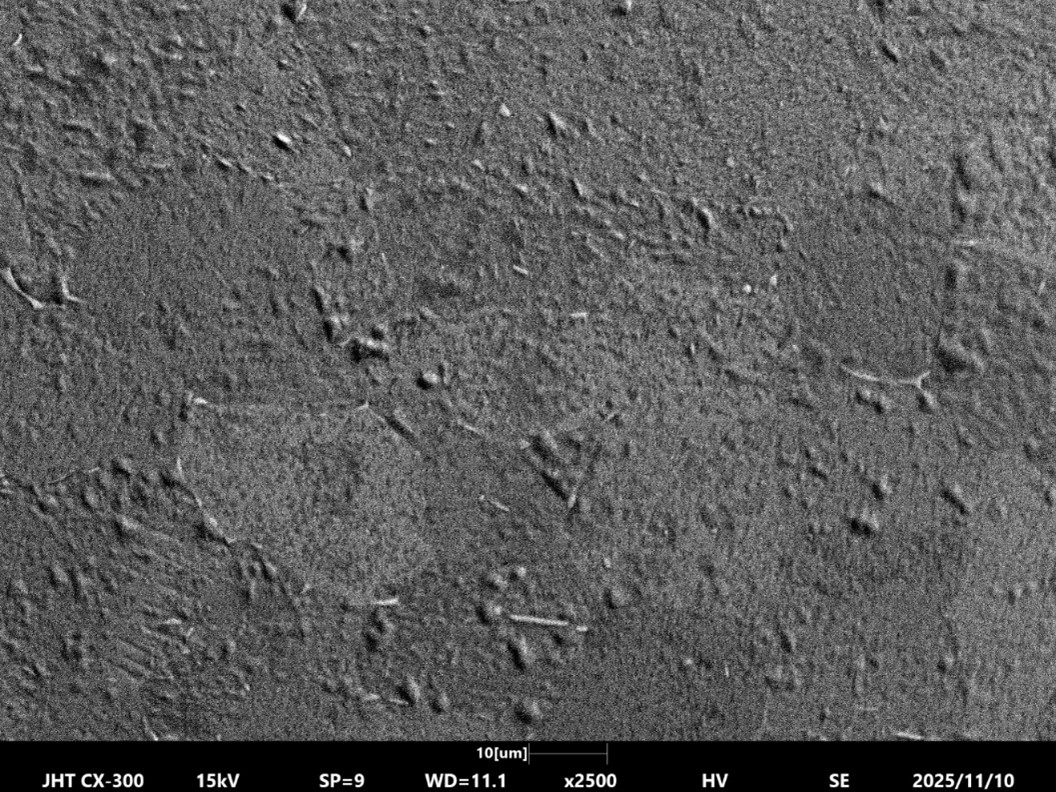
Many samples arrive in our laboratory described as “EBSD ready” because they have been polished to a bright mirror finish.
Unfortunately, optical appearance tells only part of the story.
EBSD patterns originate from only the upper tens of nanometers of the material. If polishing has introduced subsurface deformation, that damaged layer becomes part of every diffraction pattern—even when the surface itself looks perfect.
In our study, samples prepared only to a mirror finish produced:
- Less than 60% indexing
- Poor band contrast
- Heavy orientation noise
- Artificially fragmented grain structures
- Nearly identical deformation measurements for both annealed and cold-worked copper
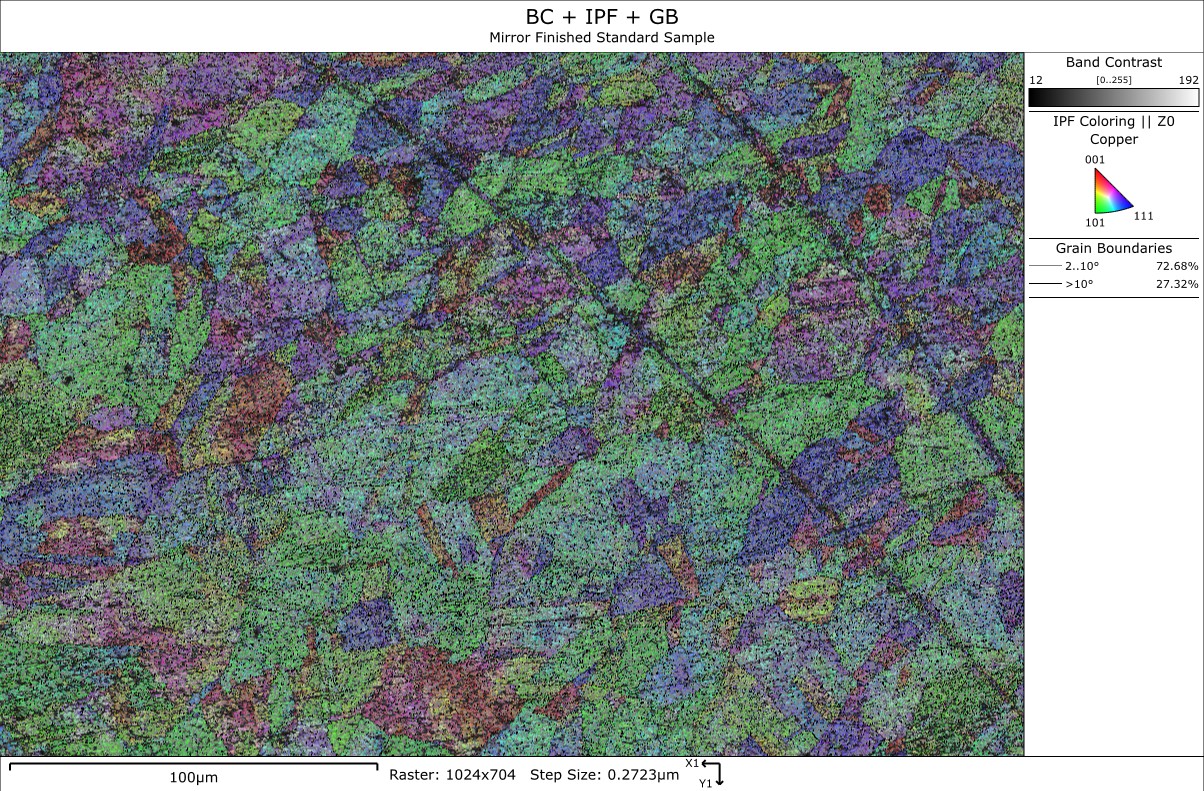
In other words, the preparation damage completely masked the real microstructure.
Comparing Four Preparation Methods
To evaluate the effect of preparation quality, two C12200 copper samples were mounted together:
- One as-received (cold worked)
- One annealed to provide a low-deformation reference
Each pair was independently prepared using one of four common workflows:
- Mirror polish
- Standard EBSD preparation
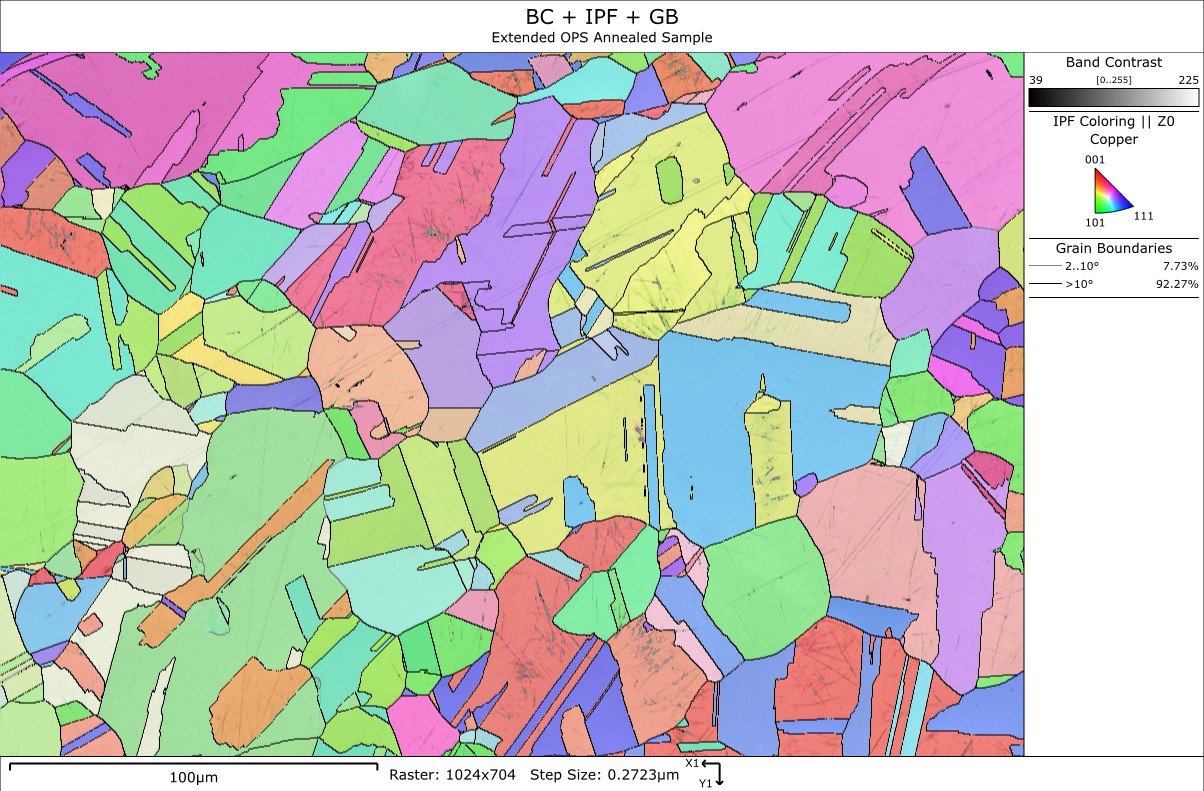
- Extended OP-S polishing
- Five-hour vibratory polishing
Running both samples side-by-side eliminated preparation variability, allowing the differences in EBSD data to be attributed solely to the polishing method.
Standard Preparation Is Better—But Still Leaves Damage
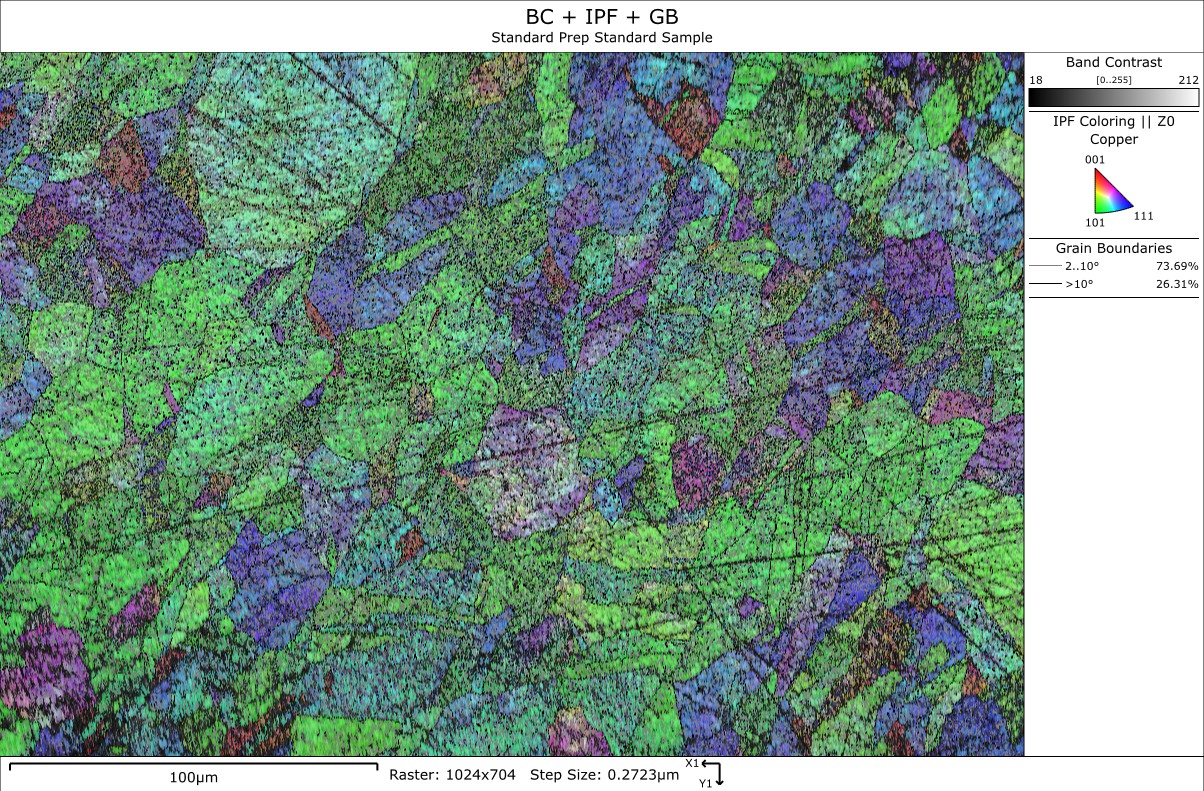
A conventional EBSD preparation sequence—including multiple grinding steps, diamond polishing, alumina polishing, and a short three-minute OP-S finish—produced a noticeable improvement.
Indexing rates increased to roughly 70%, and grain boundaries became visible. However, the data still showed:
- Elevated GND density
- High Kernel Average Misorientation (KAM)
- Residual polishing deformation
- Inflated grain counts caused by orientation fragmentation
For basic grain size measurements, this level of preparation may be acceptable after software cleanup. But for quantitative deformation analysis or high-quality EBSD mapping, significant preparation damage remains.
Twenty More Minutes Makes a Huge Difference
The biggest improvement came from one simple change:
Extending the OP-S polish from 3 minutes to 25 minutes.
The longer chemo-mechanical polishing step removed much of the subsurface deformation that conventional mechanical polishing leaves behind.
The results included:
- Nearly 100% indexing
- Dramatically higher band contrast
- Approximately 17× lower GND density
- Significantly reduced KAM
- Grain counts that closely matched the true microstructure
For most analytical EBSD applications—including texture analysis, orientation mapping, grain morphology, and phase identification—this preparation method provided excellent results without requiring excessive preparation time.
When Is Vibratory Polishing Worth It?
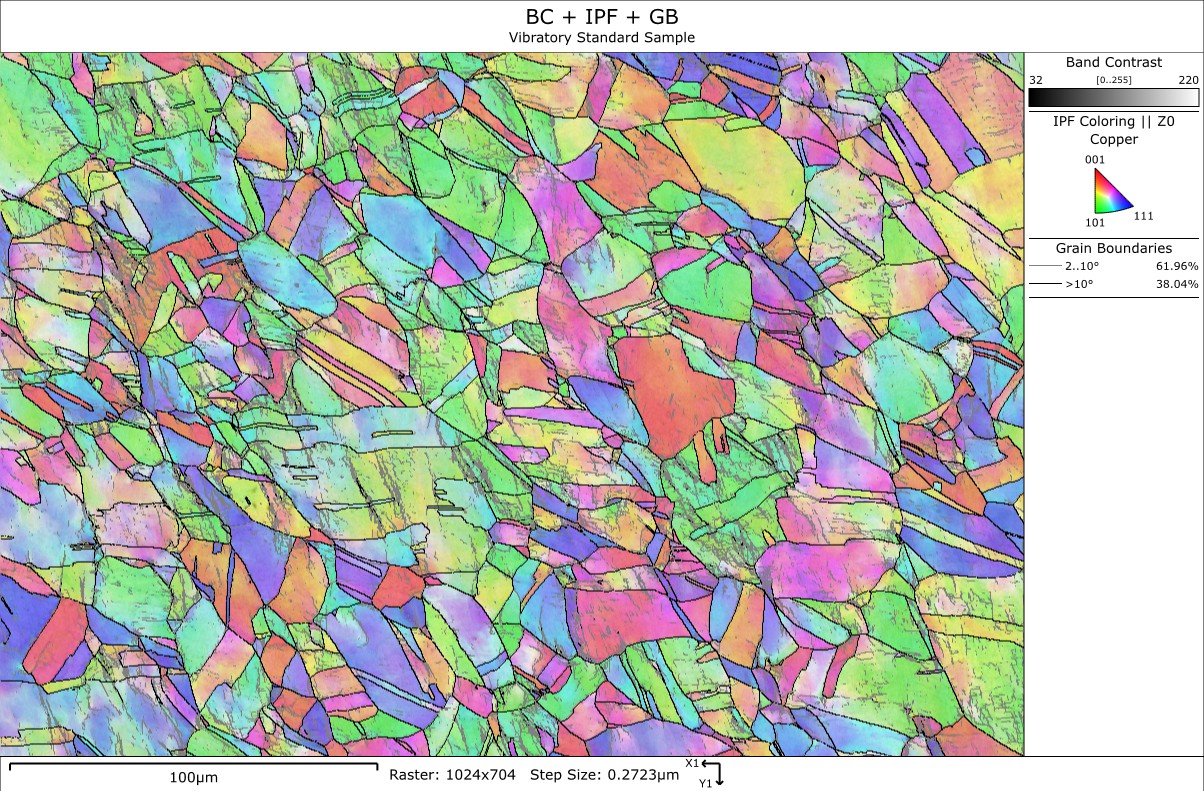
Five hours of vibratory polishing produced an interesting result.
Average EBSD metrics changed very little compared to the extended OP-S method. Indexing, GND, and KAM values were already near their practical limits.
What did improve was uniformity.
Residual polishing scratches visible after extended OP-S disappeared, and variation across the entire surface became significantly lower.
That extra preparation time is worthwhile when performing:
- Residual strain measurements
- High-resolution GND analysis
- Intragranular deformation studies
- Slip trace characterization
- Publication-quality EBSD mapping
For routine characterization, however, extended OP-S provided nearly all of the benefit in a fraction of the total preparation time.
Practical Recommendations
Based on this study, our recommendations for copper preparation are straightforward:
Avoid relying on optical appearance alone.
A mirror finish does not indicate EBSD readiness.
Standard preparation is sufficient only for basic grain statistics.
Residual deformation remains significant.
Extended OP-S polishing provides the best balance of preparation time and EBSD quality.
For most analytical work, this is the preferred workflow.
Reserve vibratory polishing for demanding research applications.
Its primary benefit is surface uniformity rather than improved average data quality.
The Importance of an Annealed Reference
One useful technique highlighted in the study was preparing an annealed reference sample alongside the material being analyzed.
Because the annealed sample contains very little intrinsic deformation, it establishes the preparation “noise floor.” Any additional deformation observed in the production sample can then be attributed to the material itself rather than polishing artifacts.
This simple approach greatly improves confidence when evaluating cold work, residual strain, or manufacturing-induced deformation.
Final Thoughts
As EBSD systems continue to improve, sample preparation increasingly becomes the limiting factor in data quality. Even the highest-performance SEM and EBSD detector cannot compensate for subsurface damage introduced during polishing.
For copper, extending the final OP-S polishing step proved to deliver the greatest improvement in EBSD performance, while vibratory polishing remains the preferred option for applications requiring exceptional spatial uniformity.
At JH Analytical Services, we routinely prepare samples for EBSD, SEM, EDS, metallography, and advanced materials characterization. Choosing the right preparation workflow is often the difference between collecting images and generating data you can trust.
Want to see the complete study—including EBSD maps, quantitative results, and detailed preparation workflows? Read the full white paper here