Author Tim Schoen, Lab Director, JH Technologies
Understanding Materials Through Crystallographic Orientation Mapping with EBSD
A material’s properties are not determined only by what it is made of. They are also influenced by how its crystals are oriented within the material.
Crystallographic Orientation Mapping provides a way to visualize and analyze those orientations across a sample. Techniques such as Electron Backscatter Diffraction (EBSD) allow researchers and engineers to investigate how crystallographic orientation relates to material behavior, grain boundaries, texture, microstructure, manufacturing processes, and overall performance.
For materials scientists, manufacturers, and failure analysis laboratories, this information can help answer an important question:
How does the material’s microscopic structure influence what it does in the real world?
Electron Backscatter Diffraction (EBSD)
EBSD is the technique identified in this article for providing crystallographic orientation mapping.
What Is Crystallographic Orientation Mapping?
Crystalline materials are made up of individual crystals, or grains, and the atoms within each grain have an ordered arrangement.
The orientation of those crystal structures can vary from one grain to another.
Crystallographic orientation mapping measures and visualizes those differences across a material. The resulting information can then be used to investigate relationships between crystallographic structure and material properties.
This is important because crystallographic orientation can influence a material’s mechanical, electrical, magnetic, and optical properties.
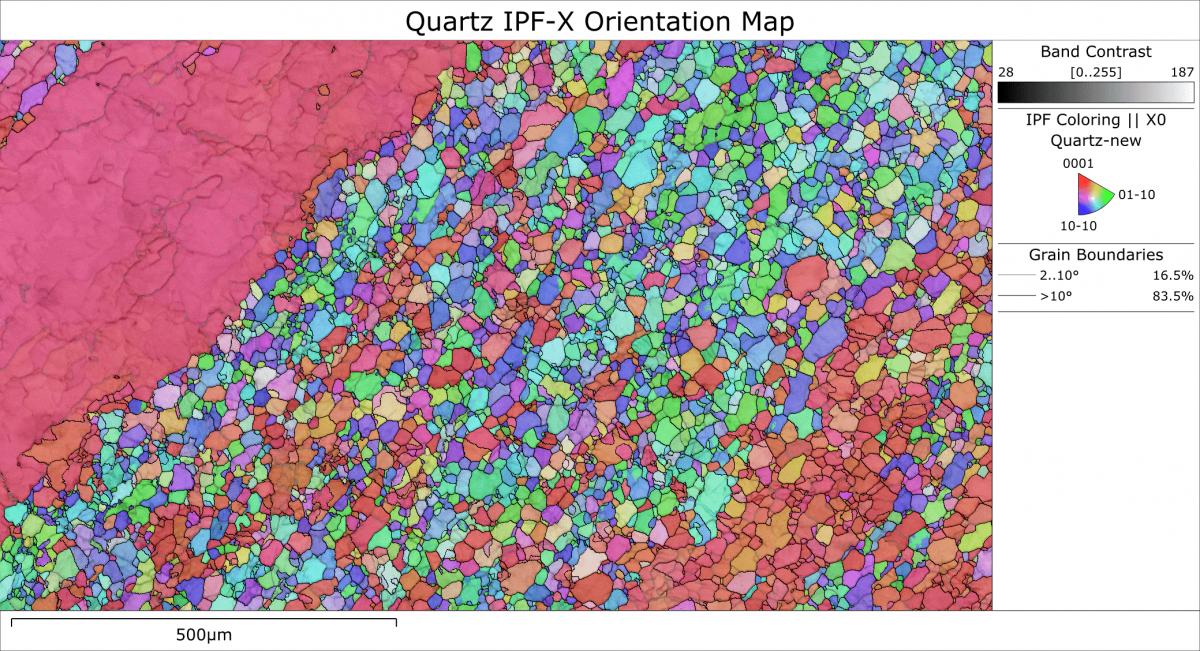
A colorful EBSD inverse pole figure (IPF) orientation map showing individual grains in different colors.
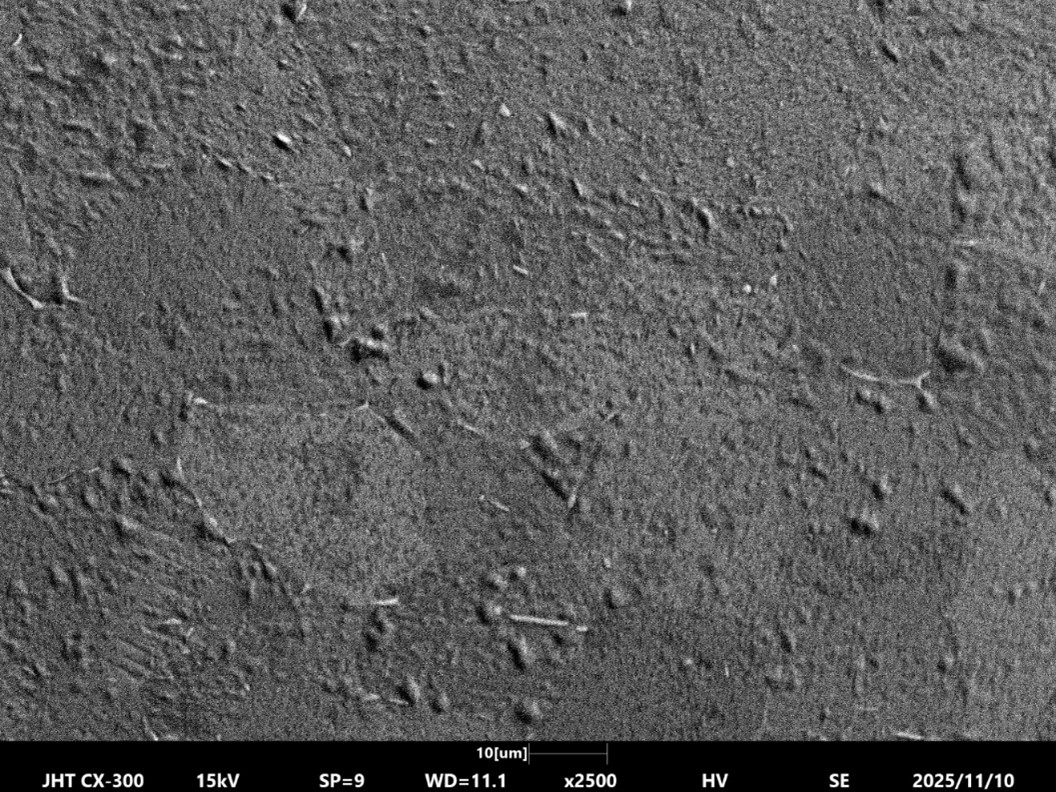
What the image should communicate: A material that looks relatively uniform in a conventional image can contain many differently oriented grains when analyzed with EBSD.
1. Understanding Material Properties
One of the most important reasons to perform crystallographic orientation mapping is to better understand how a material’s structure influences its behavior.
Different crystallographic orientations can contribute to differences in how a material responds to mechanical, electrical, magnetic, or optical conditions.
By mapping the orientations throughout a sample, researchers can see how these variations are distributed and investigate their relationship to material performance.
| What EBSD Can Reveal | Why It Matters |
|---|---|
| Crystallographic orientation | Helps understand variations in material behavior |
| Orientation distribution | Shows how grains are arranged throughout a sample |
| Relationships between structure and properties | Supports materials research and performance analysis |
For engineers developing or evaluating materials, this provides information that cannot be obtained simply by knowing the material’s chemical composition.
2. Grain Boundary Analysis
A material’s grains do not exist independently. They meet at grain boundaries, which are interfaces between adjacent crystals.
These boundaries can significantly influence mechanical and functional properties.
Crystallographic orientation mapping allows researchers to identify and characterize grain boundaries, including differences such as low-angle and high-angle boundaries and their associated misorientation angles.
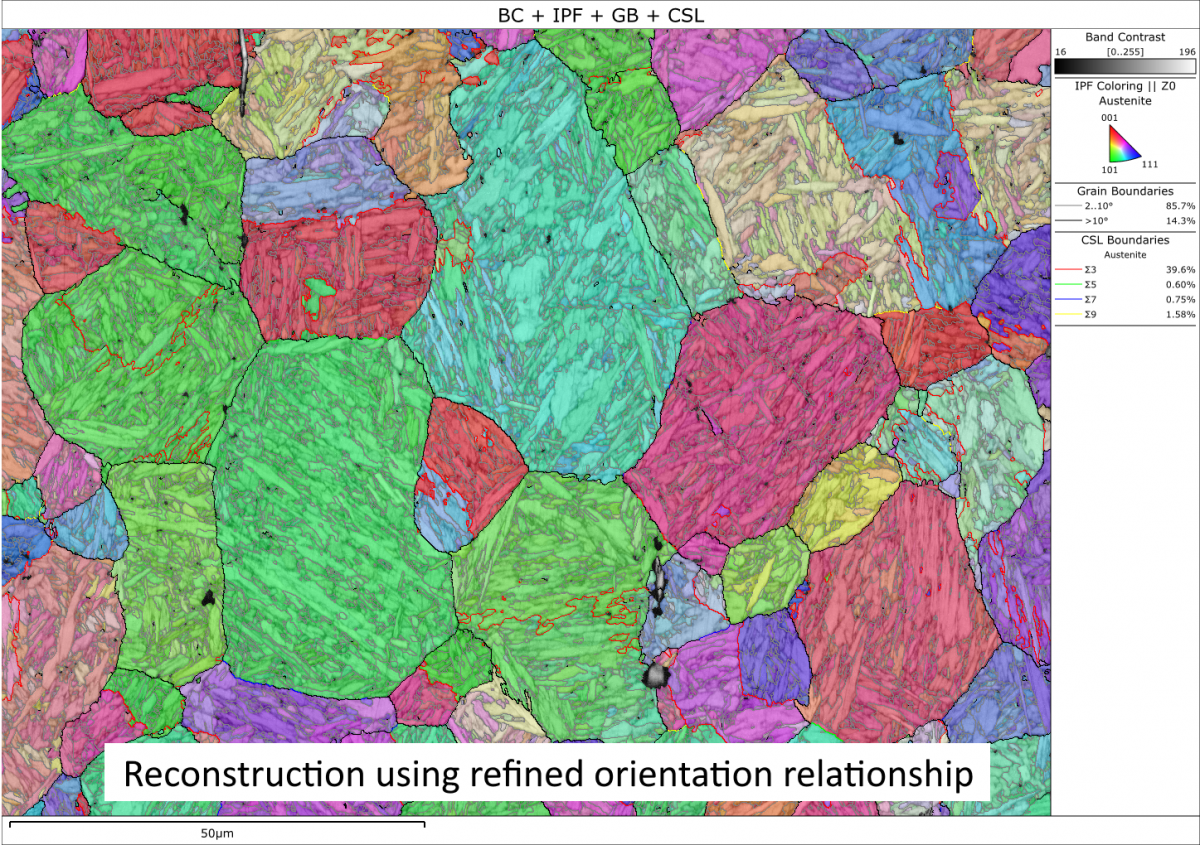
A high-resolution EBSD grain map with clearly defined grain boundaries, preferably showing grains in contrasting colors.
Best visual: A before/after-style comparison where a conventional micrograph shows the structure and the EBSD map identifies individual grains and boundaries.
Why Grain Boundaries Matter
| EBSD Information | Application |
| Grain boundary location | Identify boundaries between adjacent grains |
| Boundary type | Distinguish low-angle and high-angle boundaries |
| Misorientation angle | Characterize orientation differences between grains |
| Grain boundary distribution | Study relationships with mechanical strength and corrosion resistance |
Understanding these boundaries can help researchers investigate how grain structure affects properties such as mechanical strength and corrosion resistance.
3. Texture Analysis
Not all grains within a material are necessarily oriented randomly.
Texture describes the preferred distribution of crystallographic orientations within a material.
This orientation distribution can affect material anisotropy—meaning the material may respond differently depending on the direction in which it is tested or used.
Crystallographic orientation mapping enables researchers to quantify and visualize texture and investigate how it relates to material behavior.
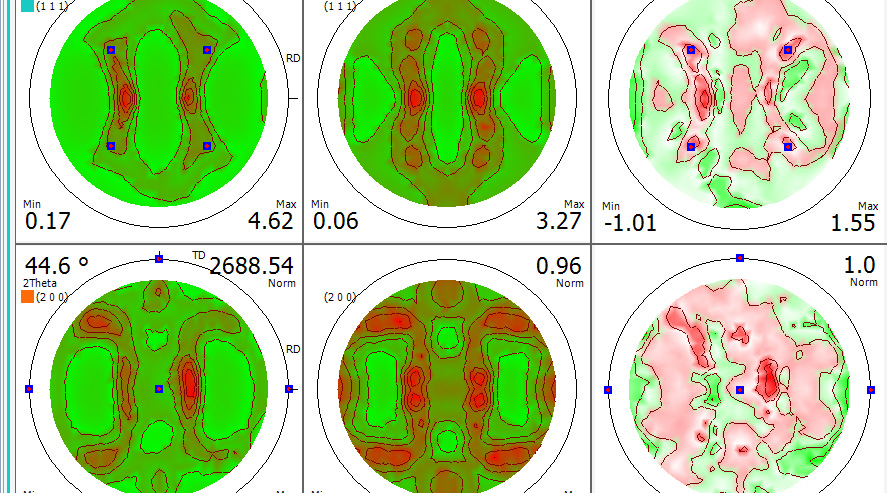
An EBSD pole figure or orientation distribution visualization alongside an EBSD grain map.
A visualization that clearly shows a preferred orientation rather than a random distribution of grains.
This type of analysis can be particularly valuable when manufacturing processes create directional microstructures.
4. Microstructure Characterization
Crystallographic orientation mapping provides detailed information about a material’s microstructure.
This can include:
- Grain size
- Grain morphology
- Twin boundaries
- Dislocations
- Other microstructural features
This information can help researchers investigate processes such as recrystallization, phase transformations, and deformation mechanisms.
| Microstructural Feature | What It Can Help Investigate |
| Grain size | Changes in material structure |
| Grain morphology | Shape and distribution of grains |
| Twin boundaries | Crystallographic relationships within the microstructure |
| Dislocations | Deformation-related behavior |
| Recrystallization | Changes resulting from material processing |
| Phase transformations | Evolution of the material’s microstructure |
| Deformation mechanisms | How the microstructure responds to applied forces |
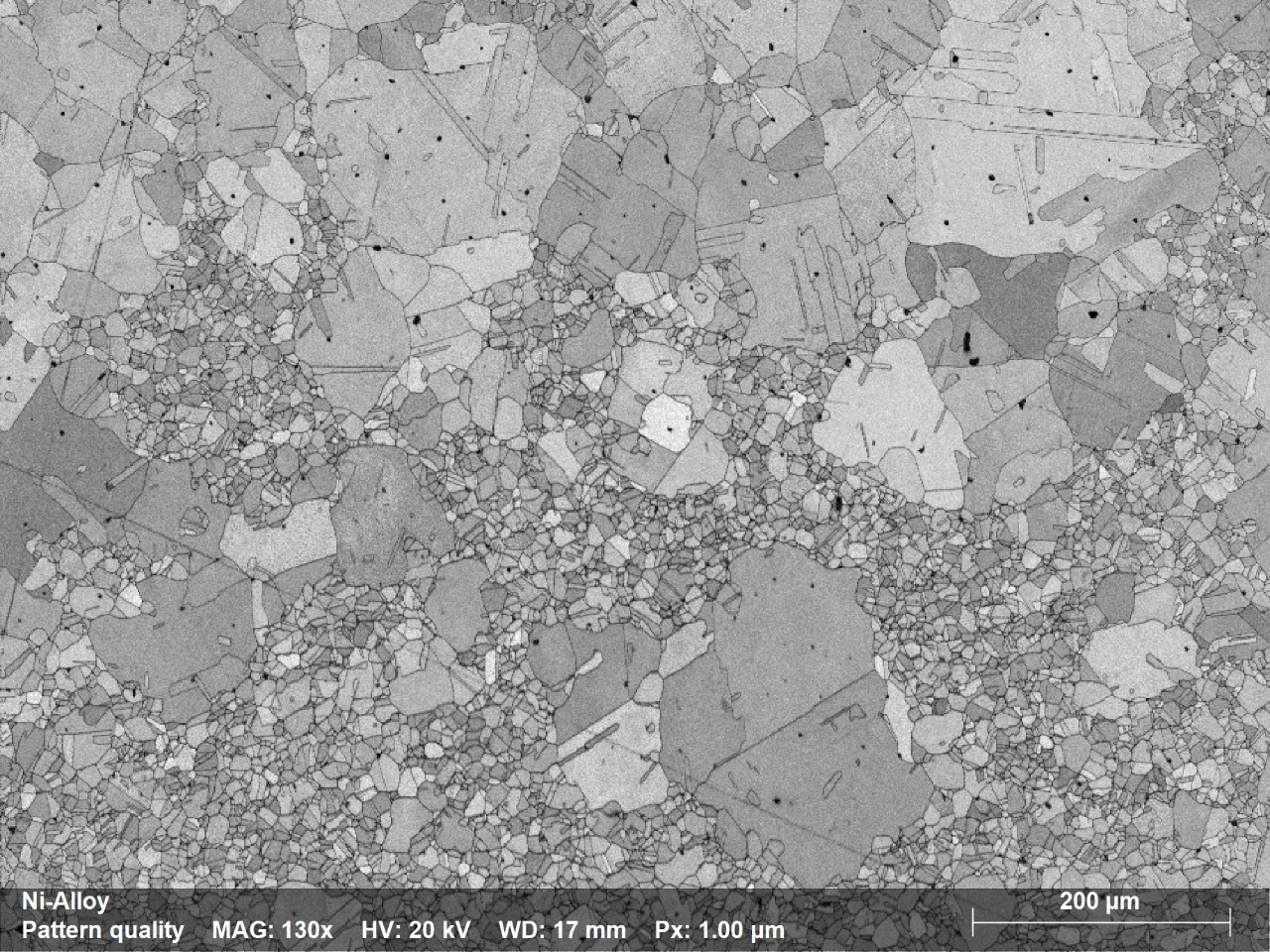
A colorful EBSD grain map showing a fine-grained or partially recrystallized material.
Ideal application: An alloy after heat treatment, deformation, or another manufacturing process where differences in grain structure are visible.
This is a particularly strong place for an application photo, because it shows that EBSD is not simply producing colorful images—it is helping explain what happened to the material during processing.
5. Quality Control and Process Optimization
Crystallographic orientation mapping can also play an important role in manufacturing.
By analyzing crystallographic orientations across grains or regions, manufacturers can identify deviations from desired material characteristics, detect potential defects or processing issues, and optimize fabrication processes.
Where EBSD Can Support Manufacturing
| Manufacturing Question | What Orientation Mapping Can Provide |
| Did processing produce the expected microstructure? | Orientation and grain structure information |
| Are there unexpected variations? | Identification of orientation differences across the sample |
| Did a processing step change the material? | Comparison of microstructural characteristics |
| Does the material meet requirements? | Data to support quality evaluation |
| Can the process be improved? | Information for process optimization |
For manufacturers, the value is not simply seeing the microstructure after production.
It is understanding whether the process produced the microstructure that was intended.
6. Materials Development and Design
Crystallographic orientation mapping can also support the development of new materials.
By studying the relationship between crystallographic orientation and material properties, researchers can work toward materials with characteristics tailored for specific applications.
Orientation mapping can also help researchers optimize processing methods to achieve desired microstructures and properties.
Bringing the Information Together
The real value of crystallographic orientation mapping comes from connecting multiple levels of information.
| Level | What Is Examined? | What It Helps Explain |
| Grain | Individual crystal orientations | Local material behavior |
| Grain Boundary | Misorientation and boundary type | Mechanical and functional behavior |
| Texture | Preferred orientation distribution | Material anisotropy |
| Microstructure | Grain size, morphology, defects | Processing and deformation |
| Material | Orientation-property relationships | Overall performance |
| Process | Changes in orientation and structure | Quality control and optimization |
This makes EBSD valuable not just as an imaging technique, but as a tool for understanding structure-property relationships.
From Microstructure to Material Performance
The connection can be thought of as a chain:
Processing → Microstructure → Crystallographic Orientation → Material Properties → Performance
Changes during manufacturing or material processing can affect the microstructure. The resulting crystallographic orientations and grain structures can then influence how the material behaves.
Crystallographic orientation mapping helps researchers investigate those relationships at the microscopic level.
That information can ultimately support:
Materials Research → Quality Control → Process Optimization → Materials Development
The original source identifies these areas as key applications of crystallographic orientation mapping.
Why Is EBSD Important?
The importance of crystallographic orientation mapping comes down to information.
A conventional image can show what a microstructure looks like.
EBSD can add information about how the crystals within that microstructure are oriented.
That additional information can help researchers and engineers investigate:
- Why a material behaves differently in different directions
- How grain boundaries influence performance
- Whether a material has a preferred crystallographic texture
- How processing changes its microstructure
- Whether a manufacturing process produced the desired structure
- How materials can be developed for specific applications
Together, these insights provide a better understanding of the relationship between a material’s structure and its properties.
JH Technologies: EBSD and Materials Characterization
At JH Technologies, advanced materials characterization helps researchers, engineers, and manufacturers understand what is happening inside their materials.
Electron Backscatter Diffraction (EBSD) provides crystallographic orientation information that can complement other microscopy and analytical techniques.
Whether the goal is to investigate grain boundaries, characterize texture, evaluate microstructure, support quality control, or understand material development, crystallographic orientation mapping can provide another level of insight into material behavior.
Equipment / Technique Highlight
Electron Backscatter Diffraction (EBSD)
Application: Crystallographic Orientation Mapping
Primary Focus: Grain orientation, grain boundaries, texture, and microstructure
Note: The source material identifies EBSD as the technique but does not specify a particular instrument manufacturer or model.
Key Takeaway
Crystallographic orientation is an important part of understanding how materials behave.
By mapping the orientation of crystals across a sample, EBSD provides insight into grain boundaries, texture, microstructure, processing effects, and structure-property relationships.
For materials research and manufacturing, that information can help move analysis beyond simply observing a material toward understanding why it behaves the way it does.