Iridium (Ir) as a Sputter Coating Material

Author Tim Schoen, Lab Director, JH Technologies

A JH Technologies overview of when iridium is worth its cost as a sputter target, and when another coating material is the better choice. 

Overview

Iridium is used as a sputter coating material in certain applications because of its unusual combination of properties. It is also rare and expensive, and it can be harder to work with than common coating metals. The choice comes down to whether your application truly needs what iridium offers, and whether that justifies the cost.
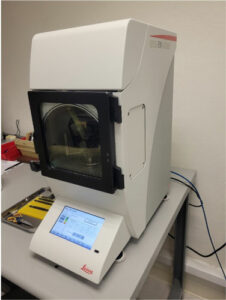
leica-em-ace600-high-vacuum-sputter-coater

Why Use Iridium?

Ion flat milling is a broad-beam sample-preparation technique. Inside a vacuum chamber, argon gas is ionized and the resulting Ar+ ions are accelerated toward the specimen. When the ions strike the surface, momentum transfer ejects surface atoms in a process called physical sputtering.

The beam approaches the surface at a shallow angle while the sample rotates or rocks. This motion distributes the ion dose across a wider area and reduces directional artifacts. The goal is not to cut deeply into the specimen. It is to remove the mechanically affected surface layer and improve the area that will be examined.

Argon is commonly used because it is inert and sufficiently massive for sputtering. That does not make the process completely damage-free. Excessive beam energy, current, time, or heat can produce new artifacts, including preferential sputtering, redeposition, pitting, or ion-induced disorder.

Table 1. Reasons to Choose Iridium for Sputter Coating

Property

Why It Matters

Chemical Stability

Highly resistant to corrosion and oxidation, even at high temperatures. Ideal for coatings exposed to harsh environments, reactive gases, or heat.

Biocompatibility

Does not cause significant adverse reactions with living tissue, making it valuable for coating medical implants and devices.

Electrical Conductivity

A good electrical conductor. Useful when a surface needs to be both conductive and chemically stable, such as electrode coatings in electronic devices.

High Melting Point

Has one of the highest melting points among all elements, making it suitable for high-temperature applications, including aerospace components exposed to extreme heat.

Catalytic Properties

Serves as an effective and stable catalyst for certain chemical processes and reactions.

Optical Properties

Can exhibit high reflectivity and low infrared emissivity, making it valuable for optical applications such as telescopes and space instruments.

Surface Modification

Thin films can improve wear resistance, reduce friction, and modify how a substrate interacts with other materials.

Research Applications

Sputtering enables researchers to deposit thin iridium films for investigating its material properties and exploring experimental applications.

Why Not Use Iridium

Challenge

Impact

Cost

One of the most expensive materials available, making it a significant limitation for large-scale or cost-sensitive applications.

Processing

Its extremely high melting point can make processing more difficult, potentially requiring specialized equipment and procedures.

Equipment Compatibility

Some sputter coaters are not designed to accommodate iridium targets, which may limit equipment compatibility.

Thickness and Uniformity

Achieving consistent, controlled film thickness and uniformity can be more challenging than with more commonly used coating materials.

Availability

As a rare element, maintaining a consistent and reliable supply can be difficult.

Film Adhesion

Achieving strong adhesion to certain substrates can be challenging. Poor adhesion may result in film delamination.

Not Always Necessary

Many applications do not require iridium’s specialized properties, and more cost-effective materials may provide sufficient performance.

Alternative Materials

Other coating materials may offer comparable or better performance for certain applications at a lower cost.

Waste and Recycling

Because of its high cost, efficient material use, recycling, and proper handling of iridium waste are especially important.

Table 2. Reasons Iridium May Not Be the Best Choice


Making the Decision
Why Use Iridium?

Iridium is the right choice when its specific properties are essential to the performance you need and the cost is justified. Before choosing it, consider:

• What your application actually requires from the coating.
• The total cost, including target material, waste handling, and recycling.
• Whether your sputter coater can accommodate an iridium target.
• Whether a more common, lower-cost coating material would perform well enough.


Contact Us

Recent Posts

CONTACT US