You Found the Particle. Now What? Automated Particle Analysis for Contamination Investigations

Author Tim Schoen, Lab Director, JH Technologies

SEM + Automated Analysis

Identify the Source. Characterize the Population. Find the Root Cause.
 

When contamination, inclusions, or foreign debris threaten your product or manufacturing process, finding a particle is only the beginning. Understanding what it is, where it came from, and how widespread the problem is requires more than visual inspection.

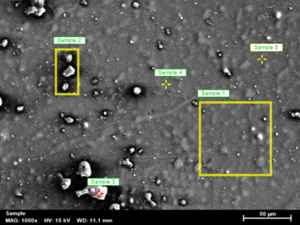
JH Analytical Labs uses Oxford Instruments’ automated particle analysis software, integrated with high-resolution SEM and EDS, to characterize thousands of particles per session. The result is detailed chemical identification, statistical analysis, and comprehensive documentation to support contamination investigations and quality control.

The Problem With How Most Labs Approach Particle Analysis?

In contamination investigations, the first question is easy: Is there a particle?

The harder questions are:

  • What is the particle made of?

  • Where in the manufacturing process did it originate?

  • Is this an isolated event or a systemic contamination problem?

  • How many particles are present across the sample population?

  • What does the particle size distribution reveal about the source?

Traditional inspection methods often struggle to answer these questions efficiently.

Optical Microscopy

  • Measures particle size and shape.

  • Provides visual information but cannot independently identify elemental composition.
Contamination-Analysis

Manual SEM/EDS Analysis

  • Provides detailed particle-by-particle chemical information.

  • Can be slow and expensive when analyzing large particle populations.

  • Introduces potential operator-to-operator variability.
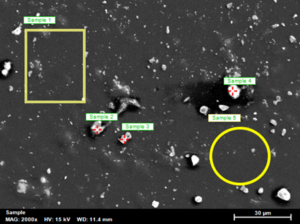
           

The result? Many investigations stop at “we found contamination” without reaching “we know what it is and where it came from.”

That information gap can delay corrective actions, product decisions, and root-cause investigations.


How Automated Particle Analysis Closes the Gap?

Oxford Instruments’ automated particle analysis software streamlines the characterization process by combining high-resolution scanning electron microscopy (SEM) with energy-dispersive X-ray spectroscopy (EDS).
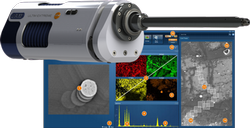
The system automatically:

  1. Scans the sample surface: Identifies particles across the selected sample area.

  2. Detects particles: Uses image thresholding and analysis algorithms to locate individual particles.

  3. Measures dimensions: Records dimensional information for each detected particle.

  4. Identifies composition: Acquires an EDS spectrum for elemental identification.

  5. Classifies particles: Applies user-defined rules to categorize particles by composition and morphology.

  6. Generates reports: Compiles particle counts, size distributions, composition statistics, and image galleries.

This automated workflow allows thousands of particles to be characterized per session without requiring operator intervention at every step.

Key Capabilities of Automated Particle Analysis?

AUTOMATED DETECTION

Every particle on the sample surface is identified and measured, reducing operator selection bias and the risk of overlooking features.

EDS ON EVERY PARTICLE

Elemental composition is identified automatically for each analyzed particle rather than relying on a limited sample of particles.

STATISTICAL SCALE

Characterizes thousands of particles per session compared with the hundreds typically handled through manual methods, providing a more comprehensive view of particle populations.

CONSISTENT CLASSIFICATION

User-defined rules categorize particles by chemistry, size, and morphology using consistent criteria.

LARGE AREA COVERAGE

Automated stage mapping covers filter media, full wafer surfaces, and large sample areas without manual repositioning.

AUDIT-READY REPORTING

Automatically generates particle counts, size distributions, composition statistics, and image galleries to support regulatory and quality documentation.

Where Automated Particle Analysis Changes the Investigation?

Automated particle analysis supports a wide range of industries and applications where identifying and understanding contamination is critical.

ApplicationIndustry / Sample TypesHow Automated Particle Analysis Helps
Contamination & Cleanliness AnalysisSemiconductor fabrication, medical devices, aerospace components, precision machiningIdentifies contamination sources, characterizes particle populations, measures size and composition, and supports quality documentation.
Failure AnalysisWear debris, foreign material, filters, and fluid samplesCharacterizes debris composition to help identify the component or manufacturing process responsible for a failure.
Powder CharacterizationMetal additive manufacturing powders, battery materials, pharmaceutical powders, catalystsEvaluates particle size distribution, morphology, and compositional uniformity.
Inclusion AnalysisMetals and materials containing oxides, sulfides, and carbidesIdentifies and quantifies non-metallic inclusions to help evaluate their relationship with material performance.
Filter & Environmental AnalysisAir filters, liquid filtration media, environmental monitoring substratesAnalyzes particles across the full filter surface to provide a more complete understanding of particle populations and composition.


Proven in Practice: Three Particle Analysis Case Studies

Automated particle analysis helps move investigations beyond identifying contamination toward determining its source.
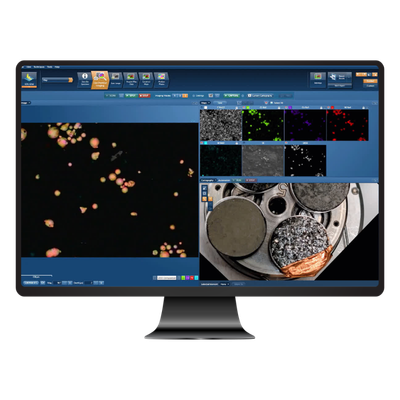
The following examples demonstrate how particle characterization supports practical root-cause investigations.

Case StudyChallengeAnalysis RevealedRoot Cause / Outcome
01 – Semiconductor Fabrication Yield LossUnexplained yield loss associated with particulate contamination on wafer surfaces.Analysis of 4,200 particles identified two distinct populations: one matching process chemicals and another matching tooling material.Two contamination sources were confirmed. Corrective actions were targeted separately, and yield loss was resolved.
02 – Foreign Debris in Medical Device AssemblyMetallic particles discovered during final inspection of a Class II medical device assembly.Particle composition matched a stainless steel alloy inconsistent with the assembly’s specified materials.Contamination was traced to a shared tooling fixture used across multiple product lines. A segregation protocol was implemented.
03 – Additive Manufacturing Powder QualificationAn aerospace supplier needed to qualify a new metal powder lot against print performance specifications.Particle size, morphology, and elemental analysis identified a satellite particle population exceeding specification limits.The powder lot was rejected before use, and the supplier qualification process was updated to include automated SEM-EDS analysis.
 

A Complete Investigation, Not Just a Particle Count

Automated particle analysis is most effective when incorporated into a complete analytical workflow.

JH Analytical Labs combines automated particle characterization with complementary microscopy and materials analysis techniques to provide a more comprehensive understanding of complex contamination and failure investigations.

Analytical StepTechnique / ServicePurpose
1. Initial AssessmentVisual inspection and optical microscopyProvides an initial evaluation of the sample and potential areas of interest.
2. Particle DetectionAutomated SEM particle detectionIdentifies particles and measures their dimensions.
3. Chemical IdentificationEDS elemental analysisIdentifies the elemental composition of individual particles.
4. Statistical AnalysisParticle population analysis and reportingEvaluates particle counts, size distributions, and composition statistics.
5. Additional AnalysisCross-sectioning and complementary techniquesProvides further insight for complex contamination and failure investigations.
6. Final InterpretationAnalytical reporting and root-cause evaluationConnects analytical findings to conclusions that support corrective action.

By combining these techniques, JH Analytical Labs helps customers move from initial observations to actionable conclusions.

Why Teams Send Samples to JH Analytical Labs

Automated particle analysis requires more than specialized software. Reliable results depend on a properly configured SEM with EDS, appropriate classification rules, and the analytical expertise to interpret the findings.

JH Analytical Labs provides the equipment, software, and applications expertise needed to characterize complex particle populations.

Our applications scientists evaluate chemical composition alongside physical observations, understand the limitations of each technique, and determine when complementary methods may provide a better answer.

What Sets Our Particle Analysis Service Apart?

CapabilityWhat It Means for Your Investigation
SCALEThousands of particles characterized per session, providing statistical insight into particle populations rather than isolated observations.
CHEMISTRY + MORPHOLOGYParticle size, shape, and elemental composition are combined within a single automated workflow.
EXPERTISEApplications scientists configure the analysis for your specific materials and contamination types, then interpret the results rather than simply collecting data.
FULL WORKFLOWSEM, EDS, EBSD, ion milling, and cross-sectioning are available under one roof when your investigation requires additional analysis.

Have a Particle Problem That Needs an Answer?

Finding contamination is only the first step. Understanding what it is, where it came from, and how widespread it is can make the difference between an unresolved investigation and an effective corrective action.
Send JH Analytical Labs your sample, whether it is filter media, a component surface, a powder lot, or a suspected failure site.

Our team can perform automated particle analysis and provide a comprehensive characterization report to help support your investigation.

We also work with laboratories evaluating Oxford Instruments equipment for in-house implementation.
 

Contact Us

Recent Posts

CONTACT US